07.10.2026
All about the belt on DJControl T10
Ask any experienced DJ what they think of a belt drive turntable, and you’ll likely hear the same verdict: “belt drive is no good for DJing.”
That reputation isn’t unfounded as most consumer belt drive turntables, the kind found in living rooms and vinyl-listening setups, were never built to handle scratching, beat juggling, or fast pitch changes. Their motors are weak, their rotation isn’t stable, and they simply weren’t designed with a DJ’s hands in mind.
This T10 system isn’t like your father’s belt driven turntable, though.
While it does use a belt to drive the platter, the engineering behind it has far more in common with a professional direct-drive DJ turntable than with a home hi-fi deck. Understanding how that belt system works reveals why the T10 has earned genuine credibility among turntablists.
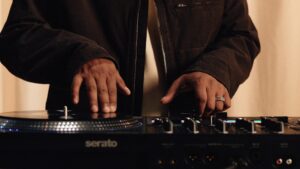
How our belt driven system works
Instead of adapting an off-the-shelf belt drive motor, the system was built from scratch (yep. pun absolutely intended) to replicate the two qualities that make a direct-drive DJ turntable feel great under the hands:
- A powerful, custom brushless motor. Hercules engineered its own brushless DC motor rather than reusing parts from portable or entry-level belt drive record players. This gives the platter enough torque to be manipulated by hand, for scratching, holding, or nudging the beat without stalling, and enough responsiveness to snap back to the correct speed the instant it is released.
- Active speed regulation. On top of raw torque, the system continuously monitors and corrects the platter’s rotation speed, like the quartz-locked speed control found on legendary direct-drive decks (you know which one). This is the piece most consumer belt drives are missing entirely, and it’s the reason cheap belt turntables tend to drift, wobble, or feel “loose”, exactly what DJs hate.
The result is a belt drive platter that is deliberately engineered to behave like a direct-drive one, while still delivering the tactile, analog feel of a metal platter, a felt slipmat, and a real vinyl record on top.
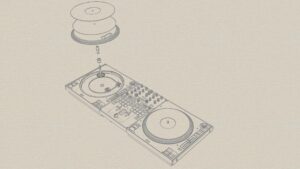
A motor with real DJ-grade torque
We didn’t guess at the torque target, we benchmarked it against the industry standard. Our internal measurements show the T10’s belt drive system produces around 0.16 N·m of starting torque, which sits right in the published range of the legendary Technics SL-1200 series (roughly 0.14–0.18 N·m across the MK2 to MK7 generations).
Reaching that number, while also validating the feel with real DJs, was the benchmark the entire project was measured against.
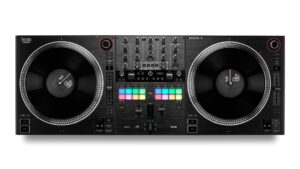
Tuned specifically for the T10’s larger platter
The T10 wasn’t simply the T7’s belt system scaled up. Hercules began the T10’s development with two full 12-inch platters and ran extensive testing with experienced DJs to fine-tune the motor, belt, speed regulation, and slipmat combination.
Because the T10’s platter is heavier than the T7’s, and because 10-inch (and full-size) play styles put more physical force through the deck, the motor on the T10 runs less restricted than on the T7, paired with a different belt and custom felt slipmats developed with Dr. Suzuki to guarantee the right amount of slip and grip under scratching.
What are the advantages of the Hercules belt drive technology?
- Direct-drive feel, without the direct-drive price tag. By engineering torque and speed regulation into a belt system rather than a direct-drive motor, Hercules made motorized, vinyl-feel DJing significantly more accessible financially, without cutting corners on performance.
- Real vinyl sensations. A 10-inch metal platter, genuine felt slipmat, and an actual vinyl record sit on top of the system, so the tactile experience of scratching and mixing feels authentic, not simulated.
- Durability built in. The motor is intentionally tuned (not simply maxed out) to reduce long-term wear on the belt. In extensive stress testing, Hercules reports that no belt has ever broken, a direct result of calibrating motor response rather than just chasing raw power.
- Validated by real DJs, not just engineers. The torque targets, belt choice, slipmat material, and speed-regulation settings weren’t decided in isolation at our quaint France office. They were shaped through iterative testing sessions with experienced turntablists and DJs of varied styles, who challenged the engineering team and pushed the system through real-world scenarios before we finalized the development.
- Portability without compromise. Thanks to this compact belt driven approach, a full turntablist setup, two T10 decks and a mixer, can travel in a backpack, at roughly the weight of a single traditional vinyl turntable.
The belt inside the Hercules T10 isn’t the same technology found in a budget living-room record player, it’s a purpose-built system engineered to match the torque and speed stability of a professional direct-drive turntable, refined through real-world testing with DJs, and packaged into a lightweight, affordable, and durable format.
For DJs who dismiss belt drive on principle, the T10 is worth a second look, and, more importantly, a first try.